What you provide
The lease and amendments, the client’s side, the event to examine and any dates needed to calculate the contractual periods.
Solutions
Read the instruments together for a specific event or contested position. Keep the competing passages, asset routes and missing evidence visible.
Choose the tool
The lease and amendments, the client’s side, the event to examine and any dates needed to calculate the contractual periods.
The other side’s rights, the client’s duties, dates derived from the lease, conflicting passages and unanswered questions for the selected event.
Review the operative lease and amendment together. A cure period in the original document may have changed, and a notice clause may determine the date from which it runs. The map follows the supplied documents; it does not replace research into governing property law.
Practice context: Real estate →
The will, trust, beneficiary forms, deeds and related evidence. Identify whether the client supports or challenges the plan.
The route each asset appears to take under the documents, inconsistent directions, gaps and grounds on which the plan could be challenged.
A will’s wording must be read alongside the documents governing the same asset. The map identifies a competing title or beneficiary route and separates what the papers say from what remains unknown. It reads no estates statute and does not state a state-law requirement as an established fact.
Practice context: Trusts and estates →
Sworn financial statements, account records, deeds, the premarital agreement and any separation-agreement draft. Enter the marriage and separation dates.
The other spouse’s proposed characterization of assets, the documentary money trail and conflicts in sworn accounts. Dates are compared with the supplied relationship timeline.
The map examines the competing readings of the file. A title document, joint payment record and later sworn statement may support different positions. It does not value assets or apply a state family-property statute, and a missing tracing record remains a gap.
Practice context: Family law →
A result, step by step / Invented sample documents
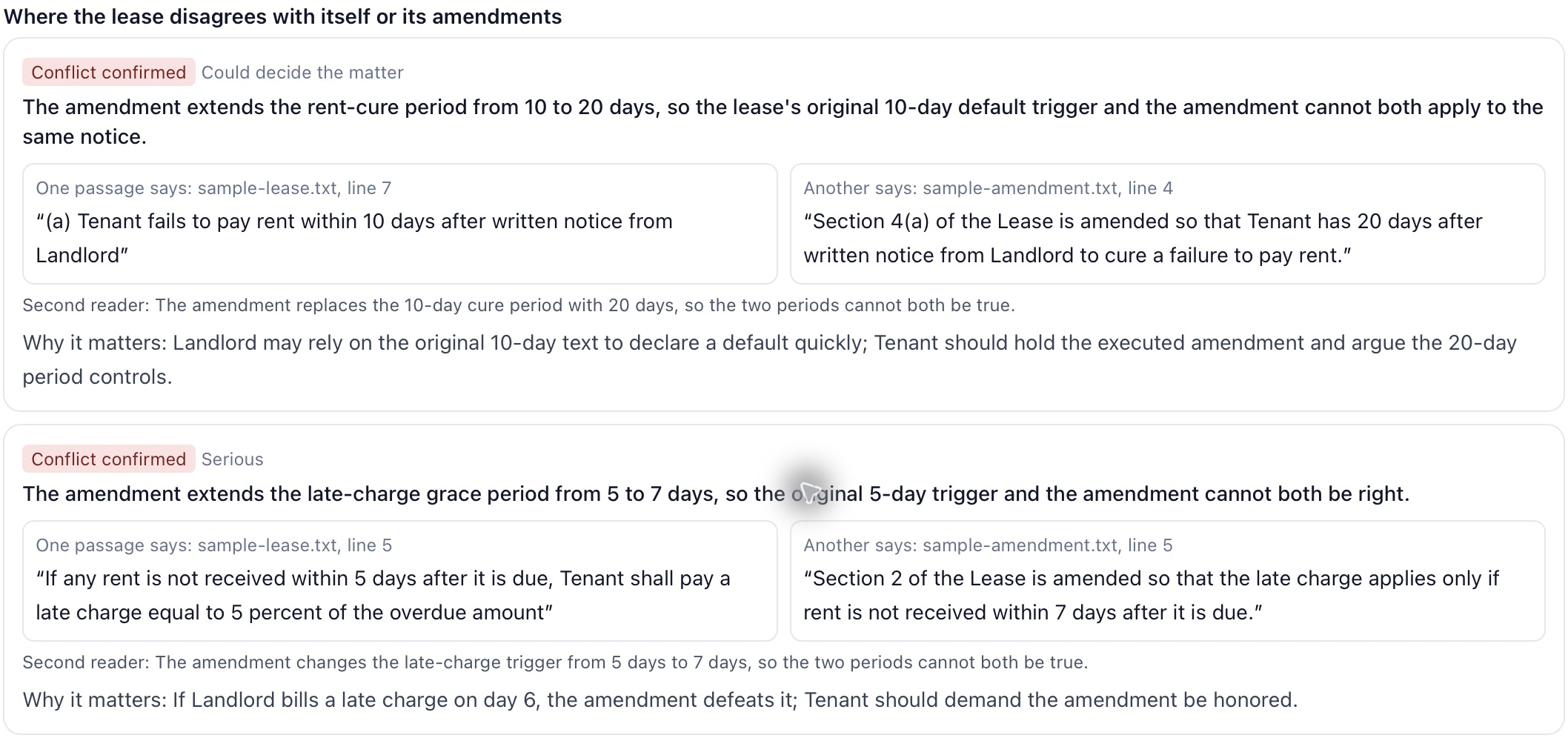
The invented commercial lease is read with its first amendment for a tenant whose rent is late. This example follows the two provisions shown in the actual Lease map capture.
Lease, line 7“(a) Tenant fails to pay rent within 10 days after written notice from Landlord”
First amendment, line 4“Section 4(a) of the Lease is amended so that Tenant has 20 days after written notice from Landlord to cure a failure to pay rent.”
The result puts the original and amended periods side by side. It identifies why reliance on the original ten-day text needs review. The lawyer checks the amendment and the notice record before deciding how to respond.
A due date cannot resolve whether an effective notice was given or whether every relevant amendment is in the file. Confirm the operative documents, the notice method and the trigger date. The map’s contractual reading does not decide enforceability under governing law.
Where this fits in a matter
During lease review and when a default, transfer, casualty, renewal or exit event occurs.
During plan coordination, administration and preparation for a potential contest.
During financial disclosure, asset tracing and preparation for negotiation or a hearing.
Questions
Include the operative instruments and documents that change or qualify them. A lease amendment can change a period, while a beneficiary form may direct an asset separately from a will. Missing instruments remain explicit gaps.
The document tools do not include a state statute pack. They compare the uploaded instruments and evidence. The lawyer researches the governing property, inheritance and execution rules separately.
No. It organizes the competing document statements and evidence. Valuation and any legal classification require further work by the lawyer.
Cortega Legal
Discuss the documents, the work and the practice’s deployment.