Rely on a different ownership account
The other spouse may point to a refinance application rather than a later financial statement. Property map places conflicting sworn accounts together and identifies the asset they concern.
Property map →Practice areas / Family law
A title document, account statement and sworn financial disclosure can describe the same asset differently. Cortega Legal reads them together to examine the other spouse’s proposed classification and the records supporting each position.
The other side’s playbook
The other spouse may point to a refinance application rather than a later financial statement. Property map places conflicting sworn accounts together and identifies the asset they concern.
Property map →A deed may predate the marriage while account records show later joint payments. The map follows the documentary money trail and distinguishes those records from a final legal classification.
Property map →A statement may place a purchase after separation while a bank entry places it earlier. Property map compares the recorded event with the marriage and separation dates supplied by the lawyer.
Property map →A deposit or withdrawal alone may not establish the source or destination of funds. The map identifies tracing gaps and what further document would help the lawyer resolve them.
Property map →Your matter, step by step
Start with the marriage and separation dates and an inventory of the property documents. Use Intake review to organize the material and the questions that need answers. Keep an incomplete account history visible as a missing item rather than treating the available statement as the whole history.
Intake review →Read sworn financial statements with the deeds, account records and applications that concern the same assets. The Property map compares the competing descriptions rather than assuming that the latest characterization resolves a difference.
Property map →Trace the money described in the file and compare acquisition dates with the supplied relationship dates. Examine which record supports the other spouse’s characterization and which link is absent. The map does not substitute a valuation or a state-law classification rule.
Property map →Review the source passages behind an asset position before relying on it in a proposed agreement. Keep the relevant statements and drafts in the matter workspace. The lawyer assesses the legal classification and the practical effect of a proposed term.
Property map and matter workspace →Return to the conflicting passage or missing tracing document rather than a summary label. Decide what evidence or explanation is still needed and mark the reviewed issue handled when the lawyer has addressed it. The tool does not decide credibility or the outcome.
Property map →Invented sample documents
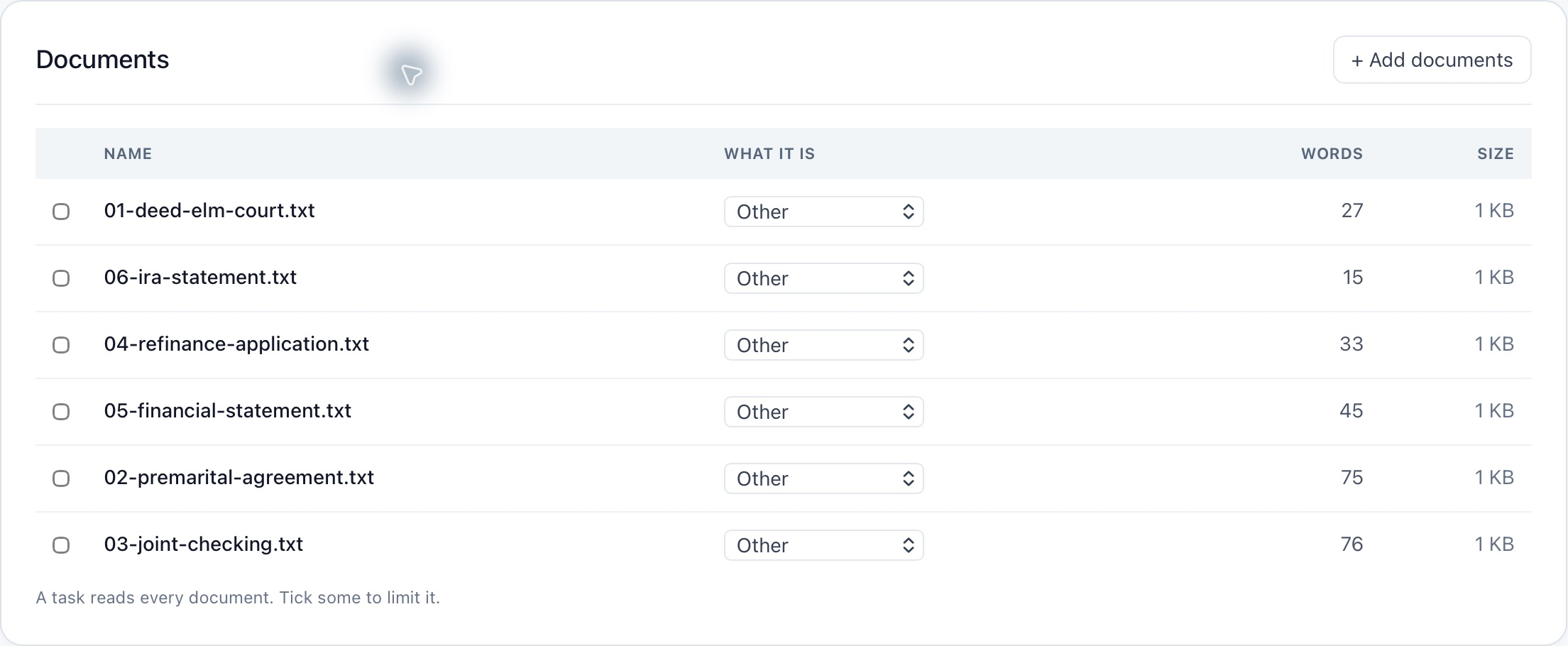
The invented file includes a deed, premarital agreement, joint bank statements, refinance application, sworn financial statement and IRA statement. These are annotated source passages; no legal classification is asserted by this example.
Sworn financial statement, line 4“House at 9 Elm Court: separate property of Dana Cole, acquired before the marriage.”
Refinance application, line 3“Dated October 12, 2018. The applicants, Dana Cole and Eli Cole, state that they jointly own 9 Elm Court. Value stated: $520,000.”
The descriptions concern the same house but give different ownership accounts. Property map is designed to expose this conflict alongside the asset and money trail. The title history, agreement and payment records must be considered before choosing the legal argument.
The available descriptions do not settle the legal character or current value of the house. The lawyer needs the complete title and tracing record and the governing state law. The supplied marriage and separation dates also need confirmation.
What it reads
Upload deeds, sworn statements, account statements, applications and the agreements bearing on ownership. Include both accounts when the spouses describe an asset differently.
Provide the records connecting deposits, transfers, payments and purchases. Enter marriage and separation dates. Missing periods in a statement history remain gaps that need investigation.
Property map examines the supplied assets, tracing records and relationship dates. It does not value assets, apply a state family-property statute or address every issue in a family matter.
What comes back
Attack results rank difficult points, separating source-supported answers from issues that need evidence or correction.
Read each quotation in context. A word match checks the source; the lawyer still assesses the legal conclusion.
Missing facts and unread material stay explicit, with the question they leave open and how to investigate it.
Attack-result check boxes record the lawyer’s follow-through after the underlying issue has been addressed.
Courts and rules covered
These are the tool packs’ recorded source-reading dates, not a statement that every rule is current or covered. The lawyer checks the applicable text, local rules and orders for the actual matter.
| Court or source | What was read | Date checked | Gaps |
|---|---|---|---|
| Property map document review | The instruments and evidence uploaded to the matter. | Per review | The result is limited to that document set. |
| State-law coverage | No state statute text is read by this tool. | Not applicable | No valuation or state family-property statute. |
Authorities named in attack results carry their check status. A quoted rule excerpt does not verify every authority or establish that a proposed argument applies.
Questions
It examines the documents and money trail. It does not provide an asset valuation. Obtain the relevant valuation evidence separately.
No state family-property statute is included in this tool. It identifies the competing documentary positions and their gaps. The lawyer applies the governing legal rules to the established facts.
The tool compares document events with the marriage and separation dates entered by the lawyer. A different date can change the timing question. Verify those inputs before assessing the result.
The comparison can show the passages concerning the same asset. That gives the lawyer a specific conflict to investigate. It does not determine which account is accurate or which legal characterization controls.
It examines the tracing documents supplied, including deposits and transfers. A gap between the source record and a later account remains visible. The result does not establish a complete trail from an incomplete statement history.
The dedicated tool described here is the property document review. Its scope is asset characterization, tracing and documentary conflicts. Other family work should not be inferred from this page.
Cortega Legal
Discuss the documents, the work and the practice’s deployment.