Point to the document outside the will
A contestant or beneficiary may rely on a later deed or account designation. Estate plan map identifies the competing route and the passage describing who receives the asset.
Estate plan map →Practice areas / Trusts and estates
A will can describe one destination for an asset while a deed or beneficiary form describes another. Cortega Legal reads the instruments together to show the routes stated in the documents, their conflicts and the questions a challenge could raise.
The other side’s playbook
A contestant or beneficiary may rely on a later deed or account designation. Estate plan map identifies the competing route and the passage describing who receives the asset.
Estate plan map →A trust may refer to a property schedule that is empty or incomplete. The map identifies that documentary gap so the lawyer can obtain funding or title evidence.
Estate plan map →The papers may describe how a document was signed or include evidence relevant to capacity or influence. The map identifies the possible challenge and source; the applicable state-law requirements need separate research.
Estate plan map →An account form may name someone whose relationship to the owner later changed. The map reads the form with the related documents without deciding the state-law effect of that change.
Estate plan map →Your matter, step by step
Collect the instruments governing the assets rather than reviewing the will alone. Use Intake review to inventory the documents and record the questions the lawyer wants answered. Include title records and beneficiary forms when they describe a route that may operate alongside the will.
Intake review →Run Estate plan map with the will, trust, deeds and beneficiary forms. Identify whether the client supports or contests the plan. Read the route assigned to each asset beside the source passage and examine a competing direction in another document.
Estate plan map →Check the plan’s descriptions against the available ownership and account records. A reference to a trust schedule does not itself establish which assets were transferred. Keep the missing funding or title evidence as an open item for investigation.
Estate plan map and matter workspace →Review the grounds raised by the file and the passages behind them. Separate a factual question about signing or influence from a conclusion about the governing law. The lawyer obtains the relevant testimony, complete instruments and state-law research before selecting an argument.
Estate plan map →Return to the original source after obtaining a missing form, schedule or deed. Reconsider the affected asset route and mark reviewed items handled when the lawyer has addressed them. The handled state records follow-through; it does not certify a transfer or validate an instrument.
Estate plan map →Invented sample documents
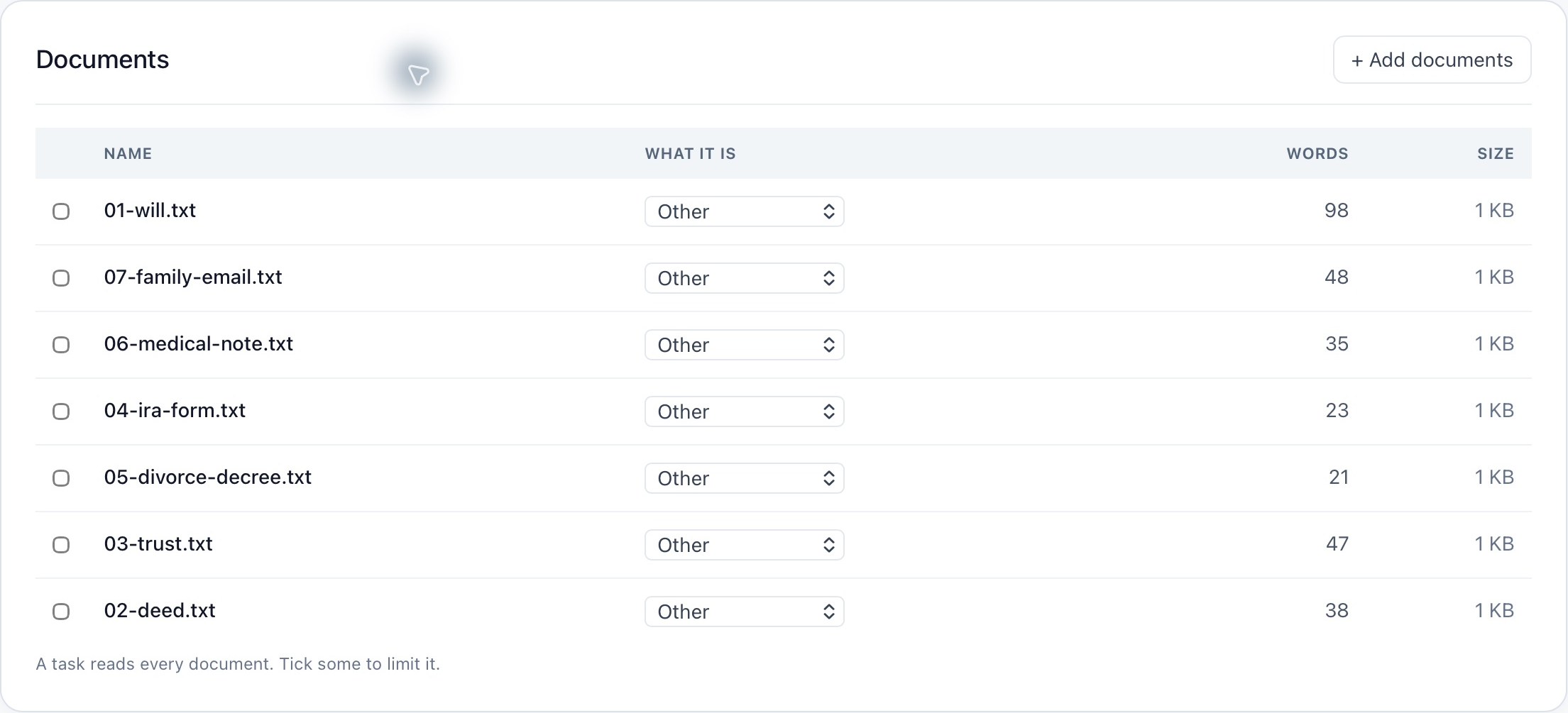
The invented estate contains a will, deed, trust, IRA beneficiary form, divorce decree, medical note and family email. The passages below illustrate a document-coordination question, not the legal effect of either instrument.
Will, line 4“2. I leave my house at 4 Oak Lane to my three children, Anna Ward, Ben Ward and Carol Ward, in equal shares.”
Deed, line 3“Helen Ward conveys the property at 4 Oak Lane to Helen Ward and Carol Ward as joint tenants with right of survivorship.”
The papers describe different routes for the same house. Estate plan map is designed to place those directions alongside the asset and identify the competing position a beneficiary could take. The trust also refers to a Schedule A that is blank in the sample.
The file does not establish the full title history, the validity or operative effect of the documents, or which assets were transferred to the trust. State-law requirements and the effect of the divorce on a beneficiary form require separate research. Those questions cannot be resolved by reading the will in isolation.
What it reads
Upload the will, trust, beneficiary forms and deeds together. A plan summary can omit the actual words creating the apparent conflict.
Include related decrees, correspondence and other evidence bearing on the document history or challenge. Identify the client’s position and obtain missing schedules and ownership records.
Estate plan map coordinates the supplied will, trust, beneficiary forms, deeds and related evidence. It reads no estates statute and does not establish compliance with a state’s execution, revocation or inheritance requirements.
What comes back
Attack results rank difficult points, separating source-supported answers from issues that need evidence or correction.
Read each quotation in context. A word match checks the source; the lawyer still assesses the legal conclusion.
Missing facts and unread material stay explicit, with the question they leave open and how to investigate it.
Attack-result check boxes record the lawyer’s follow-through after the underlying issue has been addressed.
Courts and rules covered
These are the tool packs’ recorded source-reading dates, not a statement that every rule is current or covered. The lawyer checks the applicable text, local rules and orders for the actual matter.
| Court or source | What was read | Date checked | Gaps |
|---|---|---|---|
| Estate plan map document review | The instruments and evidence uploaded to the matter. | Per review | The result is limited to that document set. |
| State-law coverage | No state statute text is read by this tool. | Not applicable | No estates statute. State-law execution, revocation and inheritance requirements require separate research. |
Authorities named in attack results carry their check status. A quoted rule excerpt does not verify every authority or establish that a proposed argument applies.
Questions
It identifies the route described by the supplied documents and the named recipient. A competing form or deed can create a conflict to investigate. The lawyer determines the instruments’ legal effect under applicable law.
The map can identify what the supplied papers say about signing and a possible challenge. It reads no estates statute. It does not certify that execution requirements were met.
The document review can identify a missing or blank schedule referenced by the trust. That is a reason to seek funding and ownership evidence. It does not by itself establish whether the trust was funded by another instrument.
The map takes whether the client supports or challenges the plan as an input. It examines arguments and documents from that perspective. The lawyer checks the resulting positions and missing facts.
No estates statute is included in the tool. The map does not state a state-law requirement as an established fact. Questions about inheritance, revocation or the effect of divorce need separate legal research.
The map can only read the documents supplied. A will or trust does not reveal every separate account designation. Obtain the missing forms before treating the apparent asset routes as complete.
Cortega Legal
Discuss the documents, the work and the practice’s deployment.