What you provide
The brief or argument to test, together with the agreement, correspondence, exhibits and witness statements it relies on.
Solutions
Read the motion, brief or expert report from the other side’s position. Start with the paper and the record behind it, then examine the argument, the source and the unanswered question.
Choose the tool
The brief or argument to test, together with the agreement, correspondence, exhibits and witness statements it relies on.
The other side’s arguments, ranked weak points, possible answers and unresolved facts. Each supported point links back to the words in the file.
Start with a position you are considering taking. The review separates a point with a source-supported answer from one that needs a correction, further evidence or a different argument. Read the unknowns before treating a missing contradiction as support for the position.
Practice context: Civil litigation →
A motion to dismiss or for summary judgment, its supporting exhibits and the documents needed to check the facts it asserts.
The opposition’s arguments, the motion’s factual dependencies, conflicts with the record and possible replies. The result identifies which missing facts could change the analysis.
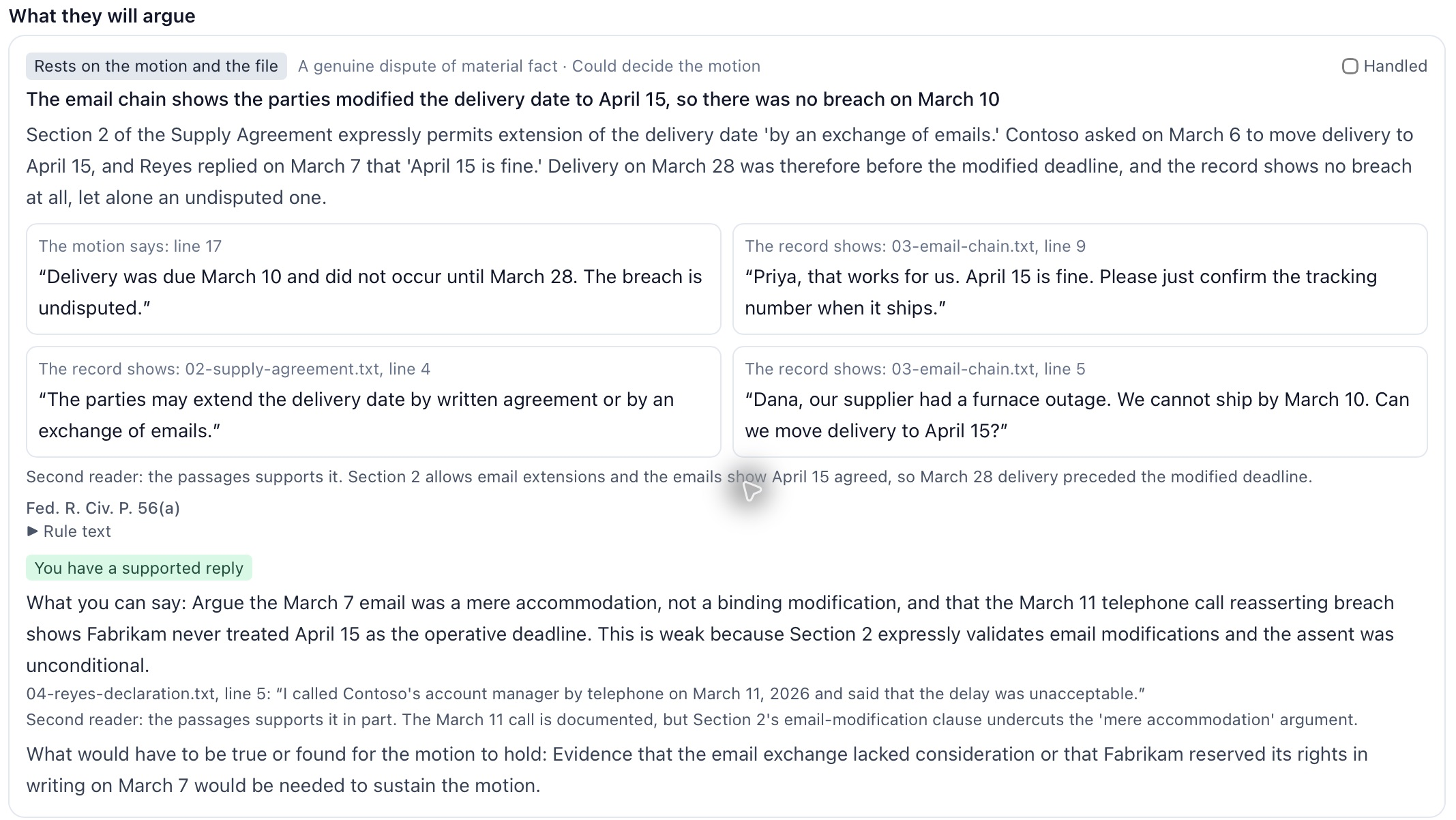
A motion’s wording determines which proposition is being tested. A date described as undisputed is checked against the agreement and correspondence in the file. A proposed reply is presented alongside its source support so the lawyer can assess whether it actually answers the objection.
Practice context: Civil litigation →
The expert report, supporting financial or technical material and the documents the opinion assumes or excludes.
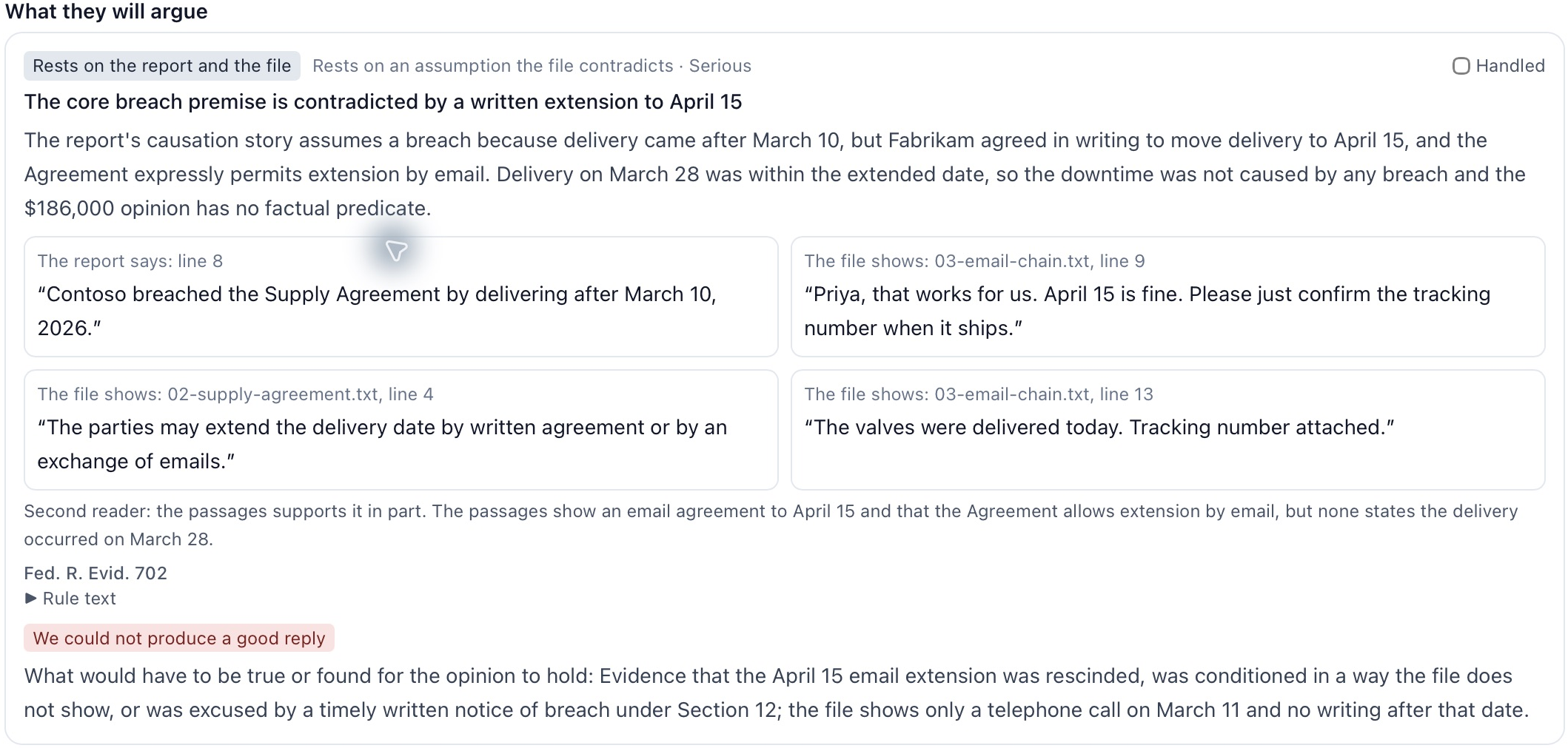
Challenges to qualifications, data, assumptions and method, plus omissions against the available report-disclosure rule text. Each point identifies the report passage that supports it.
The review distinguishes the expert’s stated assumption from an established fact. An opinion may depend on a number supplied by management or a contract the expert did not read. Use the result to identify what supporting material to request and what the expert needs to explain.
Practice context: Civil litigation →
The suppression motion, warrant and affidavit, incident reports, transcripts and other government documents relevant to the search or statement.
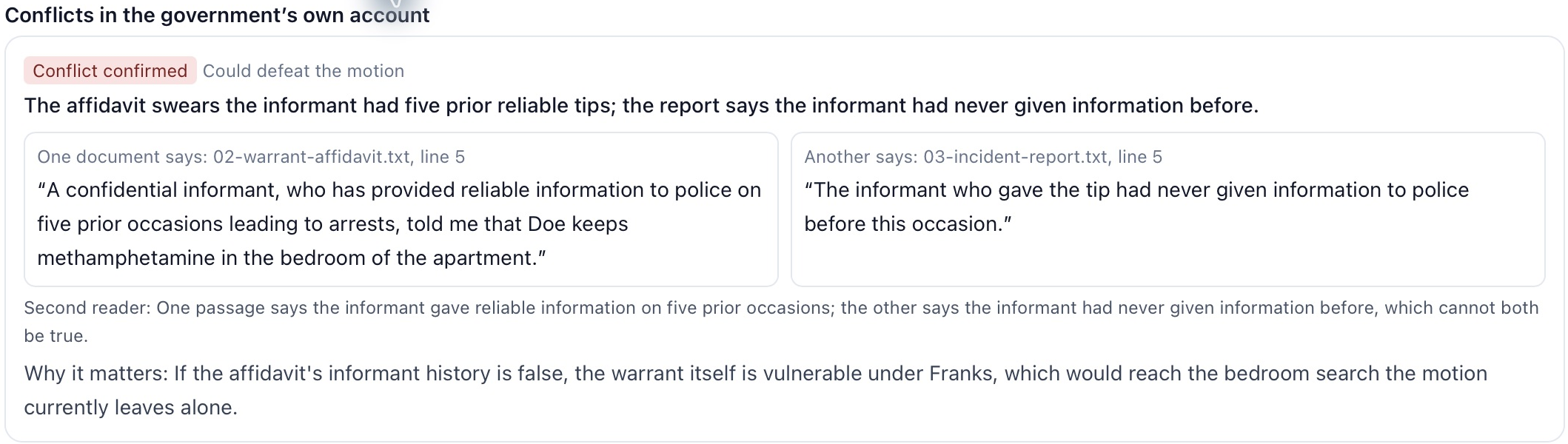
The prosecution’s response to the motion and conflicts within the government’s own account. The result shows supporting passages, possible answers and unresolved facts.
Test both the defense’s stated theory and the consistency of the documents used to oppose it. A difference between a warrant affidavit and an incident report deserves a source comparison before it becomes an argument. The tool’s text does not establish credibility or resolve a disputed event.
Practice context: Criminal and enforcement →
A result, step by step / Invented sample documents
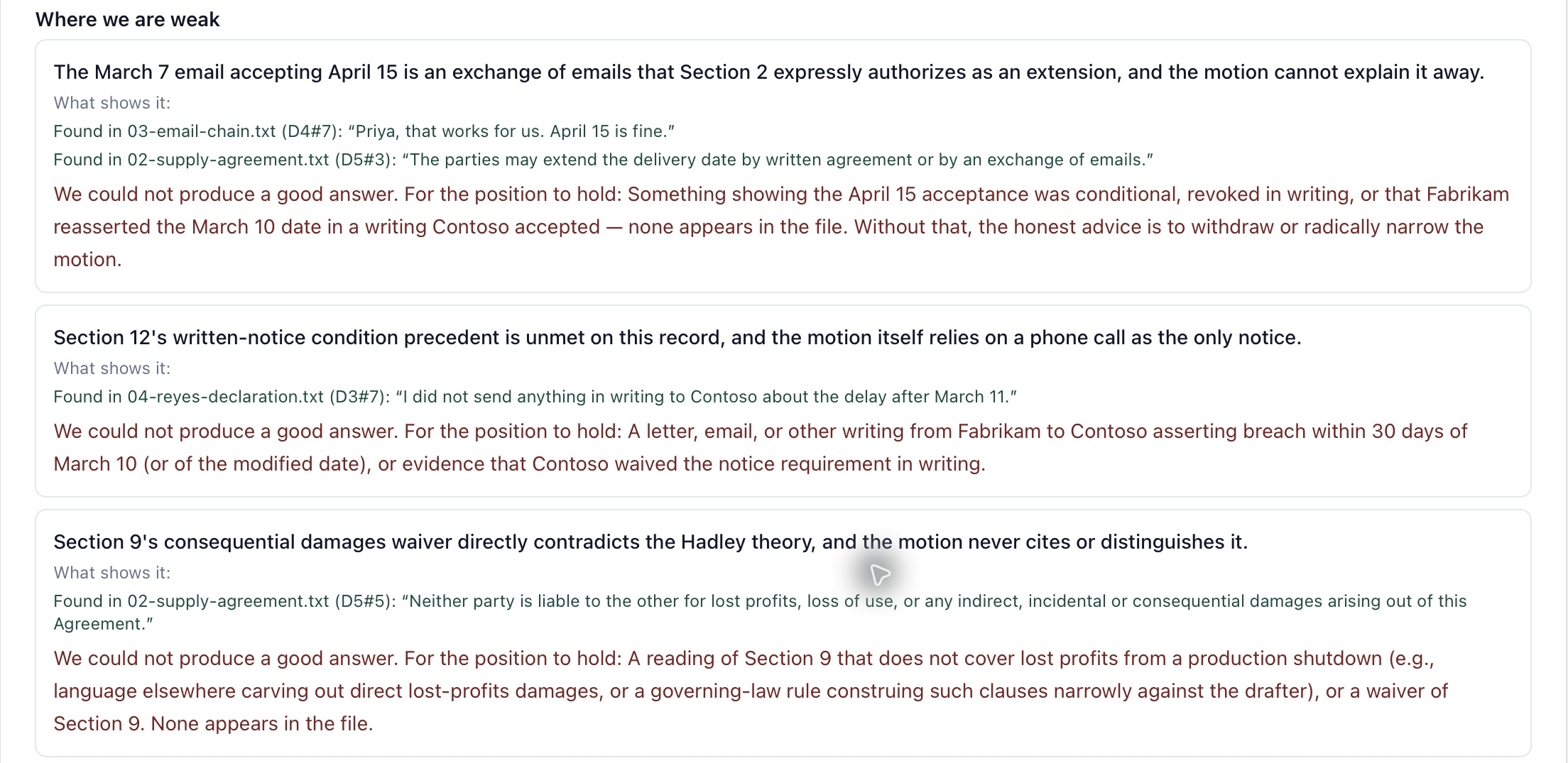
The invented file contains a summary-judgment motion, supply agreement, email exchange, declaration and delivery records. The motion relies on a March 10 deadline and seeks lost profits.
Motion, line 17“Delivery was due March 10 and did not occur until March 28. The breach is undisputed.”
Buyer email, line 9“Priya, that works for us. April 15 is fine. Please just confirm the tracking number when it ships.”
The agreement permits an extension by email. Motion review identifies that extension as a challenge to the asserted breach. The lawyer examines the complete correspondence before choosing a reply.
The result identifies missing support for an answer to the extension. It asks for evidence about the acceptance, authority or a later change. A handled mark records follow-through; it does not validate the conclusion.
Where this fits in a matter
Before committing to a theory, serving a response or filing a paper.
While drafting or revising a dismissal or summary-judgment motion.
At expert disclosure, before deposition and when reviewing a proposed challenge.
After assembling the search or interview record and before revising the suppression motion.
Questions
Motion test examines a dismissal or summary-judgment motion against the supplied record and selected court rules. Stress test examines a broader argument and possible responses. Choose the review that matches the paper, then read the source and unresolved questions.
Provide the underlying records that support or challenge the opinion. The review examines the report’s assumptions and method against that material. Missing data remains a question for the lawyer to investigate.
No. The tool uses the available rule excerpts and states source gaps. The lawyer checks applicable law, local requirements and the result’s authority status.
Cortega Legal
Discuss the documents, the work and the practice’s deployment.