Practice areas / Criminal and enforcement

Read the search record from the prosecution’s side.

A suppression theory or interview plan can depend on what the government’s own documents say about timing, consent and the person involved. Cortega Legal compares those accounts, prepares source-linked questions and makes the federal trial clock inspectable.

Actual criminal and enforcement application result detail. Invented sample documents.
Actual criminal and enforcement application result detail. Invented sample documents. Select to enlarge.

The other side’s playbook

What the file lets them challenge.

Defend the account in the affidavit

The prosecution may rely on the affidavit’s description even where a later report differs. Suppression test compares the motion with the government documents and identifies the passages a response would have to address.

Suppression test →

Offer another account of consent or sequence

A search report and a body-camera transcript may describe the same event differently. The tool shows the conflict and possible prosecution response; the lawyer must investigate what happened and obtain the complete record.

Suppression test →

Ask about a statement the client has already made

An investigator can compare an interview answer with earlier correspondence or records. Government interview prep builds likely questions from the supplied file and displays the relevant federal text alongside them.

Government interview prep →

Use a witness’s change in detail

An earlier account may differ from anticipated testimony. Impeachment map and the Cross-examination list connect the likely question to the statement that supports it. Practice room lets the lawyer inspect one practice answer at a time.

Impeachment map →

Your matter, step by step

From the first documents to the next decision.

  1. 01

    Charging papers and search documents

    Assemble the motion, warrant, affidavit, incident reports and interview or body-camera transcripts before selecting a theory. Keep the source of each account identifiable. A missing transcript, an incomplete warrant packet or an uncertain event time should be recorded as a question rather than filled in from a summary.

    Matter workspace →
  2. 02

    Suppression review

    Select the defense motion and provide the government’s documents. Read the prosecution’s possible answer beside the conflict that prompted the motion. Check whether an apparent inconsistency rests on a quoted passage, what reply the file supports and which factual question needs testimony or another record.

    Suppression test →
  3. 03

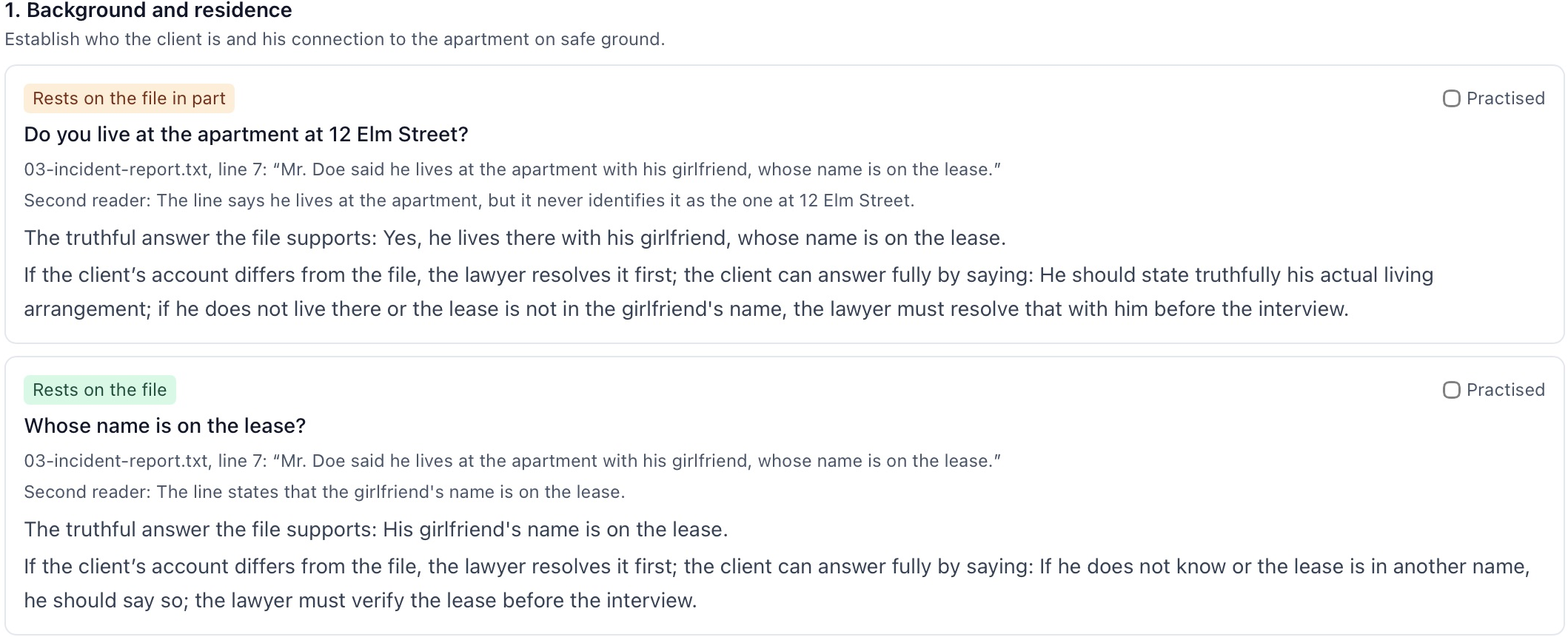
    Client and witness interviews

    Identify whose account is being prepared and the questions that the file raises. Government interview prep shows likely questions alongside the false-statement statute and Fifth Amendment text. The lawyer separately advises on participation, applicable rights and responses in the real investigation.

    Government interview prep →
    View the application result
    Actual application detail. Invented sample documents.
    Actual application detail. Invented sample documents. Select to enlarge.
  4. 04

    Federal trial time

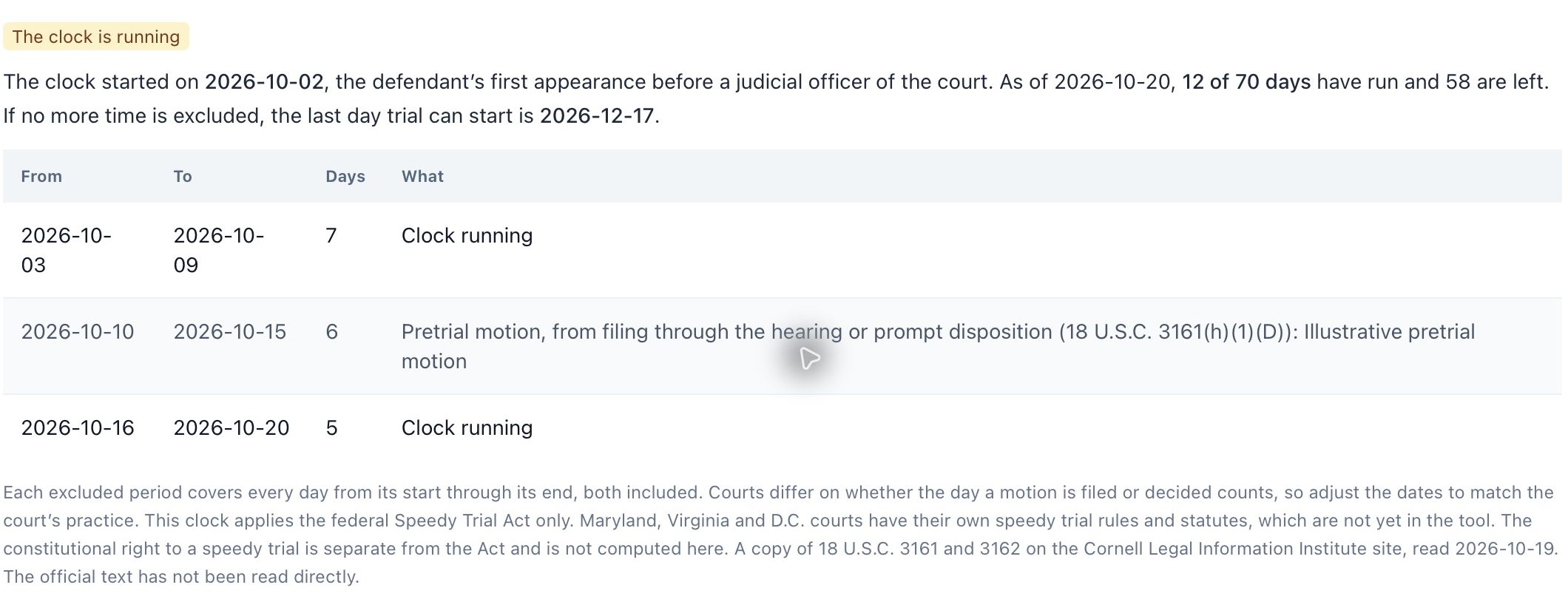
    Enter the charge date, first appearance and every proposed exclusion. Give each period its start, end, type and an explanatory note. Read the elapsed and excluded days before relying on the projected last trial-start date. Revisit the ledger whenever the underlying events change.

    Speedy trial clock →
    View the application result
    Actual application detail. Invented sample documents.
    Actual application detail. Invented sample documents. Select to enlarge.
  5. 05

    Preparation for testimony

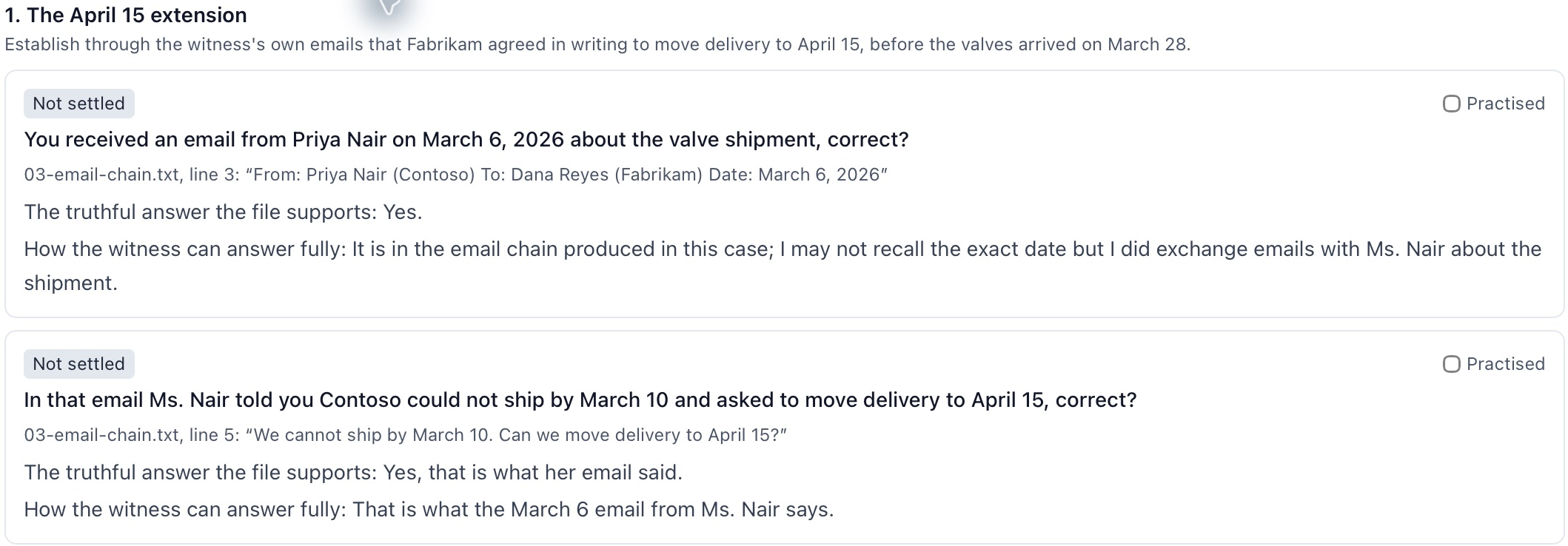
    Use the Impeachment map to compare statements, then build the Cross-examination list from the actual record. Practice room reviews an answer to one question at a time. The lawyer can pause on a discrepancy, inspect the source and determine whether the witness’s memory or the document set needs further investigation.

    Witness preparation →
    View the application result
    Actual application detail. Invented sample documents.
    Actual application detail. Invented sample documents. Select to enlarge.

Invented sample documents

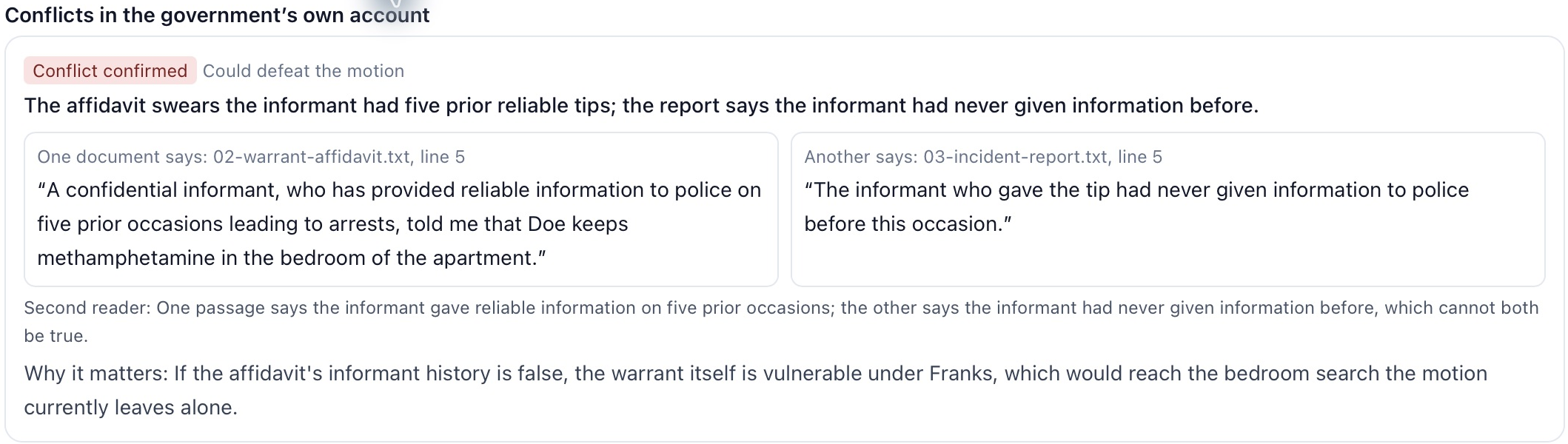
Two accounts of the informant

  1. 1. Read the document set

    The invented search file includes a suppression motion, warrant affidavit, incident report and body-camera transcript. The passages below are an annotated document comparison, not a ruling on the search.

  2. 2. Examine the exact passages

    Warrant affidavit, line 5

    “A confidential informant, who has provided reliable information to police on five prior occasions leading to arrests, told me that Doe keeps methamphetamine in the bedroom of the apartment.”

    Incident report, line 5

    “The informant who gave the tip had never given information to police before this occasion.”

    The two descriptions raise a question the suppression review is designed to expose. A lawyer can examine how the prosecution might reconcile them and which account the motion relies on. The discrepancy itself does not establish the outcome of a suppression hearing.

  3. 3. Resolve what remains unknown

    The documents do not establish which description is accurate or supply the complete basis for the warrant. Obtain the underlying records and relevant testimony. A separate disagreement about consent or the timing of warnings also requires the complete factual account.

What it reads

Build the file around the question.

Search and statement records

Upload the motion, warrant packet, reports and transcripts together. Preserve the distinction between a transcript’s words, a report’s account and the lawyer’s proposed inference.

Interview preparation

Provide the client’s or witness’s account and the records an interviewer may use. The tool’s questions depend on those documents; it cannot anticipate an unseen interview file.

Clock entries

Enter actual event dates and excluded periods separately. The ledger uses the supplied dates and types. An omitted event can change the result even if every displayed calculation follows its inputs.

Suppression review, government interview and witness preparation, and the federal Speedy Trial Act ledger. State criminal procedure and state speedy-trial coverage are limited as described below.

What comes back

The point, the passage and the work still to do.

01

Where to focus first

Attack results rank difficult points, separating source-supported answers from issues that need evidence or correction.

02

The exact quote and line

Read each quotation in context. A word match checks the source; the lawyer still assesses the legal conclusion.

03

What the tool could not see

Missing facts and unread material stay explicit, with the question they leave open and how to investigate it.

04

What the lawyer has handled

Attack-result check boxes record the lawyer’s follow-through after the underlying issue has been addressed.

Courts and rules covered

Read the source status with the result.

These are the tool packs’ recorded source-reading dates, not a statement that every rule is current or covered. The lawyer checks the applicable text, local rules and orders for the actual matter.

Court or sourceWhat was readDate checkedGaps
Federal suppression reviewSelected Fourth and Fifth Amendment and criminal-procedure excerpts; Cornell LII copies.19 Oct 2026No circuit decisions. The federal confession statute, 18 U.S.C. 3501, was not read.
D.C. suppression reviewConstitutional text and selected D.C. criminal-rule text from a rule copy.19 Oct 2026Official D.C. rule files were not read directly.
Maryland and Virginia suppression reviewThe available constitutional text.19 Oct 2026State warrant, rights and suppression-procedure gaps remain stated in the result.
Government interview preparation18 U.S.C. 1001(a) and Fifth Amendment text; Cornell LII copies.19 Oct 2026Official text was not read directly. This is not a complete account of interview rights or governing law.
Federal speedy-trial clockSelected 18 U.S.C. 3161 and 3162 text; Cornell LII copy.19 Oct 2026State speedy-trial rules and the separate constitutional analysis are not computed.

Authorities named in attack results carry their check status. A quoted rule excerpt does not verify every authority or establish that a proposed argument applies.

Questions

Using this review in your matter.

Does suppression review tell me whether evidence will be excluded?

It presents the prosecution’s response and conflicts in the supplied records. The lawyer assesses the facts, controlling decisions and applicable procedure. The result does not predict what the judge will decide.

Does it cover Maryland criminal rules?

The suppression tool identifies Maryland gaps, including the pretrial-motion rule and state warrant and rights provisions it has not read. It can still compare the documents and display the available constitutional text. The lawyer must supply the missing Maryland research.

Is the clock a state speedy-trial calculator?

The clock addresses the federal Speedy Trial Act. It shows the input periods and the federal count. State rules and the separate constitutional right to a speedy trial are outside that calculation.

What if the government’s records disagree?

The comparison can show the conflicting passages and the question they create. It does not choose which witness or document to believe. Use the result to identify the missing record or testimony needed to investigate the difference.

Does interview prep advise the client to speak?

It prepares likely questions from the file and displays the federal source text described below. Advice about participation and rights remains the lawyer’s work. The question list does not make that decision for the client.

Can I practice answers with a witness?

Practice room compares one entered answer with the matter documents. The source comparison helps the lawyer examine a discrepancy. The lawyer remains responsible for preparation and for distinguishing memory, uncertainty and a document’s account.
Cortega Legal

Review an invented matter with us.

Discuss the documents, the work and the practice’s deployment.